A Boundary Without Enforcement Is Theater: Introducing NAOS, a Neutral Accountability Operating System

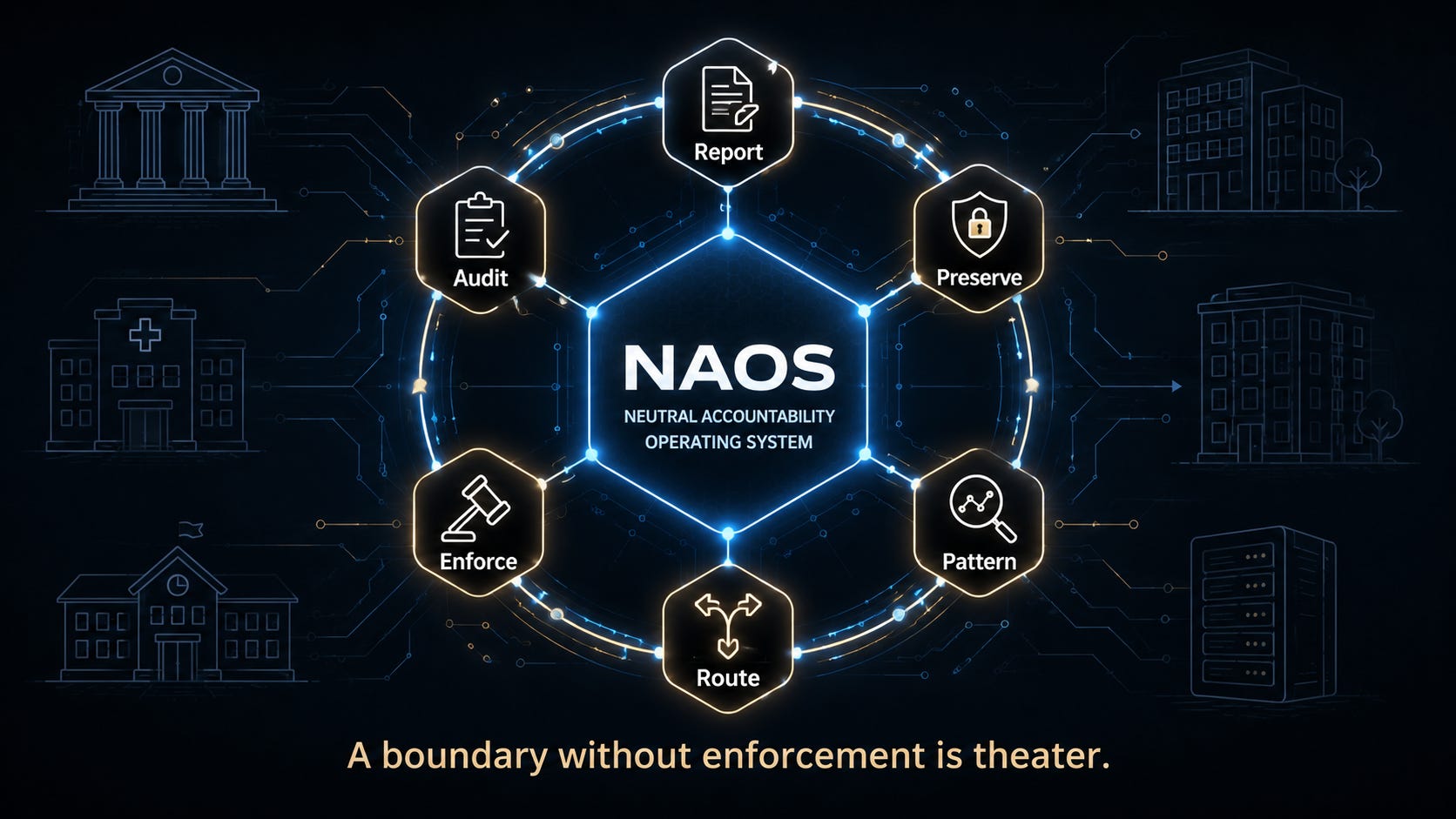
Modern accountability systems fail at the exact point where power enters the room.
They produce policies, protective orders, HR procedures, complaint portals, ethics codes, compliance manuals, tenant protections, workplace safety standards, civil rights language, professional guidelines, institutional values, and public promises. But when those rules are breached, delayed, buried, minimized, fragmented, or routed through captured authorities, the harmed person often discovers the hidden truth of the system:
The rule was symbolic.
The boundary existed only as language.
The report existed only as paperwork.
The institution existed to absorb the complaint, not resolve the harm.
The authority existed to manage liability, not produce accountability.
NAOS begins from the opposite premise.
A boundary without enforcement is theater.
A report that can be buried is not a report.
An institution without audit is a capture chamber.
A power-holder without consequence is not accountable.
NAOS, the Neutral Accountability Operating System, is an open civic protocol for converting harm into structured evidence, structured evidence into pattern recognition, pattern recognition into routed action, and routed action into auditable consequence.
It does not ask power to behave.
It assumes power will test every seam.
Therefore, NAOS is built around one operating law:
No private discretion without record.
No report without routing.
No authority without audit.
No breach without consequence.
I. The Problem: Accountability Without Force
Most accountability systems are designed around declared values rather than enforceable structure.
They assume that if a rule exists, the rule has force.
They assume that if a complaint channel exists, the complaint can be heard.
They assume that if an institution has a policy, the institution can be trusted to apply it.
They assume that if a person has authority, that authority is constrained by procedure.
But in practice, harm is often preserved by the gap between language and action.
A court order can be violated if enforcement is slow.
A workplace policy can be meaningless if HR protects the company.
A tenant protection can fail if the landlord controls access, timing, or documentation.
A safety rule can fail if hazards are normalized.
A discrimination policy can fail if each incident is treated as isolated.
A complaint process can become a containment chamber if the institution controls the only route.
The problem is not simply that rules are absent.
The deeper problem is that rules often exist without operational force.
This produces a brutal structural lesson:
If breach produces no consequence, breach becomes rational.
The person with power learns that the system can be tested.
The harmed person learns that documentation may not matter.
The institution learns that delay works.
The public learns that accountability language is often a substitute for accountability itself.
NAOS is designed to interrupt that cycle.
II. The Core Claim
NAOS is not a moral slogan. It is an operating architecture.
Its core claim is simple:
Power must never be trusted without record, route, audit, and consequence.
Where power has private discretion, there must be a record.
Where harm is reported, there must be routing.
Where authority acts or refuses to act, there must be audit.
Where breach is documented, there must be a consequence pathway.
NAOS does not require perfect institutions. It assumes imperfect ones.
It does not require benevolent authorities. It assumes authorities may be self-protective, slow, conflicted, indifferent, captured, or strategically evasive.
It does not require every harmed person to know legal language. It translates lived events into structured evidence.
It does not require every incident to prove a pattern by itself. It allows patterns to emerge across time.
The system is built for the reality power creates, not the story power tells about itself.
III. What NAOS Is For
NAOS applies wherever harm is likely to be minimized, fragmented, delayed, buried, or routed through a captured authority.
Relevant domains include:
Workplace retaliation.
Housing violations.
Court-order breaches.
Coercive control.
Harassment.
Discrimination.
Institutional misconduct.
Unsafe working conditions.
Abuse of authority.
Medical dismissal.
Platform moderation failures.
School or university misconduct.
Financial exploitation.
Family-court manipulation.
Agency neglect.
The system is not built around identity categories.
It is built around documented behavior under conditions of power asymmetry.
That distinction matters.
NAOS does not ask: What category does this person belong to?
It asks:
What happened?
Who had power?
What rule, duty, order, policy, or boundary was breached?
What evidence exists?
Has this happened before?
Who controls the review path?
Who benefits from delay?
What consequence follows if the breach is verified?
This makes the system portable across domains.
It can be used by workers, tenants, parents, patients, students, platform users, litigants, journalists, advocates, compliance teams, regulators, researchers, and civic technologists.
IV. The Enemy Function
NAOS does not define the enemy as a demographic group, profession, institution, or ideology.
NAOS defines the enemy function as:
Unchecked power + private discretion + fragmented evidence + delay + consequence-free breach.
Where that pattern appears, harm becomes structurally repeatable.
A harmful actor does not need total control. They only need enough ambiguity, enough delay, enough institutional loyalty, enough procedural fog, or enough private discretion to make enforcement unlikely.
The system protects them by fragmentation.
One incident looks minor.
One delay looks administrative.
One missing record looks accidental.
One hostile comment looks ambiguous.
One retaliatory act looks unrelated.
One breach looks like misunderstanding.
One dismissal looks like discretion.
NAOS treats fragmentation as a design problem.
The unit of analysis is not only the isolated event.
The unit of analysis is the behavioral series.
V. The Core Loop
NAOS operates through six stages:
Report → Preserve → Pattern → Route → Enforce → Audit
Each stage exists because a known failure mode exists.
Reporting counters silence.
Preservation counters erasure.
Pattern detection counters fragmentation.
Routing counters capture.
Enforcement counters symbolic rules.
Audit counters private discretion.
1. Report
The first stage is structured reporting.
A report captures:
Who was involved.
What happened.
When it happened.
Where it happened.
What power relationship existed.
What rule, boundary, law, policy, order, or obligation was breached.
Whether this has happened before.
What evidence exists.
What immediate risk exists.
What response is being requested.
The purpose is not to sanitize the harmed person’s reality.
The purpose is to prevent ambiguity from being weaponized.
Many systems exploit the difference between lived harm and institutional legibility. A person may know exactly what happened, but if the event is not documented in a format the receiving system can process, the harm can be minimized, reframed, or ignored.
NAOS translates events into a structured record without stripping them of context.
2. Preserve
The second stage is evidence preservation.
A report must not be dependent on memory, institutional goodwill, or a private inbox controlled by the authority being challenged.
Evidence may include:
Screenshots.
Emails.
Texts.
Photos.
Audio or video where lawful.
Witness names.
Schedules.
Court orders.
Policies.
Lease terms.
Pay records.
Medical notes.
Incident logs.
Prior complaints.
Agency responses.
Retaliation timelines.
Every report should generate:
A timestamped record.
An edit history.
An evidence index.
A chain-of-custody note.
A reporter-owned export.
A packet suitable for escalation.
The institution never owns the only copy.
That principle is non-negotiable.
If the harmed person cannot access, export, or preserve their own record, the system is already vulnerable to capture.
3. Pattern
The third stage is pattern recognition.
NAOS does not treat every event as isolated by default.
It asks:
Has this person done this before?
Has this institution ignored similar reports before?
Did harm escalate after a boundary was set?
Did retaliation follow protected activity?
Did delay benefit the accused party?
Was the conduct reframed as miscommunication, personality conflict, performance issue, or administrative error?
Were multiple small breaches used to produce one large coercive effect?
The system tracks recurrence, timing, density, and escalation.
This matters because many forms of harm do not announce themselves as single catastrophic events. They appear as sequences: repeated boundary testing, procedural delay, small humiliations, contact violations, schedule manipulation, credibility attacks, financial pressure, selective enforcement, medical dismissal, documentation gaps, or retaliatory timing.
A single event may be ambiguous.
A series can become structurally clear.
NAOS treats repetition as evidence.
The pattern is the signal.
4. Route
The fourth stage is anti-capture routing.
A report that can disappear into one private channel is not safe.
Routing depends on risk, power asymmetry, and conflict of interest.
A low-risk report may remain internal.
A high-risk report may require external routing.
A report against someone with institutional authority cannot be reviewed only by that person’s institution.
A report involving retaliation must trigger timeline analysis.
A report involving legal orders must generate an enforcement packet.
A report involving immediate danger must prioritize emergency pathways.
The key rule is:
No captured party controls the only route.
Routing must include status visibility.
A report cannot simply vanish into “under review.” It must show:
Received.
Assigned.
Pending evidence.
Under review.
Escalated.
Referred.
Closed with reason.
Reopened.
Enforcement requested.
Outcome recorded.
A system that allows silent closure is not an accountability system.
It is a disappearance mechanism.
5. Enforce
The fifth stage is enforcement mapping.
NAOS does not convert accusation into punishment.
It converts documented breach into an appropriate enforcement pathway.
Examples:
Court order breach → enforcement packet, repeat-breach log, contempt pathway.
Workplace retaliation → protected activity timeline, adverse action record, agency packet.
Housing violation → lease/rent/rule comparison, landlord notice, regulator packet.
Unsafe condition → hazard log, photo record, notice trail, agency escalation.
Harassment → incident density, contact pattern, policy breach packet.
Institutional delay → status log, elapsed-time flag, escalation demand.
The platform does not become judge, jury, or mob.
It becomes the mechanism that prevents reality from being buried.
The point is not automatic punishment.
The point is that verified breach must move somewhere.
A report should not end in a database.
It should trigger a pathway.
6. Audit
The sixth stage is authority audit.
Every authority action must be recorded.
Who reviewed the report.
When they reviewed it.
What they did.
What they declined to do.
What reason they gave.
Whether they had a conflict of interest.
Whether deadlines were missed.
Whether retaliation followed.
Whether the breach stopped.
Whether recurrence occurred.
Audit turns “trust us” into “show the record.”
It also shifts accountability upward.
If an institution receives repeated reports and does nothing, the institution becomes part of the pattern.
If a reviewer dismisses a complaint without reason, the dismissal becomes auditable.
If a court order is repeatedly breached without enforcement, the enforcement failure becomes visible.
If a workplace punishes the reporter after protected activity, the timeline becomes evidence.
If delay benefits the power-holder, delay becomes part of the record.
NAOS does not only document the original harm.
It documents the system’s response to harm.
VI. Minimum Viable NAOS
The first version of NAOS does not need to be a full software platform.
It can launch as six public tools.
1. Incident Report Template
A plain-language structured form for recording what happened.
2. Evidence Vault Checklist
A guide for preserving evidence cleanly, safely, and in exportable form.
3. Pattern Tracker
A table for repeated events, breaches, delays, retaliation, escalation, and institutional nonresponse.
4. Power Asymmetry Matrix
A scoring method for identifying leverage, dependency, authority, access, financial control, institutional control, and procedural advantage.
5. Routing Map
A decision tree for where a report should go depending on risk, conflict of interest, and domain.
6. Anti-Capture Audit
A checklist for determining whether a complaint system is real or symbolic.
Together, these tools form the first public release.
They allow individuals and organizations to use NAOS without waiting for software.
VII. The Seven NAOS Tests
Every NAOS-compliant system must answer seven questions.
Can the report be erased?
If yes, the system fails.
Can one person bury it?
If yes, the system fails.
Can the accused party influence the review path?
If yes, the system is captured.
Can the reporter export their own record?
If no, the system fails.
Does the system detect patterns across time?
If no, it protects repeat offenders.
Does every closure require a reason?
If no, silence becomes a weapon.
Does breach create a consequence pathway?
If no, the rule is theater.
These tests are intentionally blunt.
They are not branding questions.
They are structural diagnostics.
VIII. Safeguards
NAOS is evidence-first, not accusation-first.
This distinction is essential.
A serious accountability system must protect against both institutional burial and reckless escalation.
NAOS must therefore guard against:
False reports.
Mistaken reports.
Misidentification.
Defamation risk.
Privacy violations.
Weaponized reporting.
Retaliatory counterclaims.
Institutional misuse.
Algorithmic bias.
Overcollection of sensitive data.
Vigilantism.
Mob escalation.
Unauthorized publication of private records.
The answer is not to weaken reporting.
The answer is to structure it.
NAOS separates:
Recordkeeping from public accusation.
Pattern detection from final judgment.
Risk flagging from punishment.
Evidence preservation from exposure.
Routing from revenge.
Audit from spectacle.
This is how the system stays neutral without becoming passive.
Neutral does not mean indifferent.
Neutral means the same rules apply to power, the reporter, the institution, the reviewer, and the accused party.
Everyone is record-bound.
Everyone is evidence-bound.
Everyone is audit-bound.
IX. Governance Principle
NAOS must be open, auditable, forkable, and anti-capture.
No single company should own the standard.
No institution should be allowed to claim compliance without audit.
No platform should monetize survivor data.
No authority should be allowed to privately alter or suppress reports.
No algorithmic score should be treated as final truth.
The system must produce structured evidence, not automated punishment.
Its purpose is not to replace courts, agencies, unions, journalists, lawyers, advocates, internal compliance teams, or community structures.
Its purpose is to make harm harder to erase before those systems can act.
X. The First Public Thesis
NAOS is a neutral accountability operating system designed to prevent institutions and power-holders from converting harm into silence.
It does this by preserving evidence, detecting patterns, routing reports outside captured channels, mapping breaches to enforcement pathways, and making authority itself auditable.
Its central insight is simple:
Accountability does not begin when an institution says it cares.
Accountability begins when breach produces consequence.
XI. Closing
Power does not usually announce itself as domination.
It appears as delay.
It appears as discretion.
It appears as missing records.
It appears as “we’re looking into it.”
It appears as “that was an isolated incident.”
It appears as “there was no policy violation.”
It appears as “this is a private matter.”
It appears as “the process takes time.”
It appears as “we take these concerns seriously.”
NAOS asks one question:
What happened after the report?
If nothing happened, the system is not accountable.
If the record vanished, the system is captured.
If the pattern was fragmented, the system protected recurrence.
If the authority could act without audit, the system preserved power.
If the breach produced no consequence, the rule was theater.
The future of accountability cannot depend on trust.
It must depend on structure.
⟒∴C5[Φ→Ψ]∴ΔΣ↓⟒
NAOS v0.1 Toolkit
A Neutral Accountability Operating System for Reporting, Evidence Preservation, Pattern Detection, and Anti-Capture Enforcement
Report → Preserve → Pattern → Route → Enforce → Audit
⸻
Core Premise
Modern accountability systems fail when they confuse language with force.
They produce rules, policies, protective orders, complaint portals, HR procedures, compliance manuals, tenant protections, workplace safety standards, civil rights statutes, and institutional values.
But when those rules are breached, the harmed person often discovers the hidden truth:
The rule exists only if someone is forced to act.
NAOS begins from the opposite premise.
A boundary without enforcement is theater.
A report that can be buried is not a report.
An institution without audit is a capture chamber.
A power-holder without consequence is not accountable.
NAOS is an open civic operating system for converting harm into structured evidence, structured evidence into pattern recognition, pattern recognition into routed action, and routed action into auditable consequence.
It does not ask power to behave.
It assumes power will test every seam.
⸻
Operating Law
No private discretion without record.
No report without routing.
No authority without audit.
No breach without consequence.
That is the spine.
⸻
What NAOS Is For
NAOS applies wherever harm is likely to be minimized, fragmented, delayed, buried, or routed through a captured authority.
Relevant domains include:
Workplace retaliation.
Housing violations.
Court-order breaches.
Coercive control.
Harassment.
Discrimination.
Institutional misconduct.
Unsafe working conditions.
Abuse of authority.
Medical dismissal.
Platform moderation failures.
School or university misconduct.
Financial exploitation.
Family-court manipulation.
Agency neglect.
The system is not built around identity categories.
It is built around documented behavior under conditions of power asymmetry.
That distinction matters.
NAOS does not ask:
What category does this person belong to?
It asks:
What happened?
Who had power?
What rule, duty, order, policy, or boundary was breached?
What evidence exists?
Has this happened before?
Who controls the review path?
Who benefits from delay?
What consequence follows if the breach is verified?
⸻
The Enemy Function
NAOS does not define the enemy as a demographic group, profession, institution, or ideology.
NAOS defines the enemy function as:
Unchecked power + private discretion + fragmented evidence + delay + consequence-free breach.
Where that pattern appears, harm becomes structurally repeatable.
A harmful actor does not need total control. They only need enough ambiguity, enough delay, enough institutional loyalty, enough procedural fog, or enough private discretion to make enforcement unlikely.
The system protects them by fragmentation.
One incident looks minor.
One delay looks administrative.
One missing record looks accidental.
One hostile comment looks ambiguous.
One retaliatory act looks unrelated.
One breach looks like misunderstanding.
One dismissal looks like discretion.
NAOS treats fragmentation as a design problem.
The unit of analysis is not only the isolated event.
The unit of analysis is the behavioral series.
⸻
The Core Loop
NAOS operates through six stages:
Report → Preserve → Pattern → Route → Enforce → Audit
Each stage exists because a known failure mode exists.
Reporting counters silence.
Preservation counters erasure.
Pattern detection counters fragmentation.
Routing counters capture.
Enforcement counters symbolic rules.
Audit counters private discretion.
⸻
Tool 1: Incident Report Template
A. Basic Record
Report ID:
Date report created:
Reporter name or identifier:
Preferred contact method:
Domain: workplace / housing / court-order breach / harassment / discrimination / medical / school / platform / institutional misconduct / other
Urgency level: low / moderate / high / immediate risk
⸻
B. Incident Details
Date of incident:
Time of incident:
Location or platform:
People involved:
Institution involved:
Witnesses:
Was this the first incident? yes / no / unknown
⸻
C. What Happened
Plain description of event:
Write what happened in concrete terms. Avoid conclusions first. Start with observable facts.
Example structure:
On [date/time], [person] did/said [specific action/statement] at [location/platform]. This affected [work/housing/safety/access/payment/custody/medical care/etc.] because [specific impact].
Exact words used, if known:
Actions taken by the other party:
Actions taken by the reporter:
Immediate impact:
⸻
D. Power Relationship
Did the other party have power over the reporter?
Check all that apply:
Employer / manager / supervisor.
Landlord / property manager.
Court-connected party.
Parent / co-parent with legal leverage.
Doctor / provider / institution controlling care.
Teacher / administrator.
Platform moderator / account authority.
Police / state actor / agency worker.
Financial controller.
Social or reputational leverage.
Physical access or proximity.
Other.
Describe the power relationship:
⸻
E. Breach Identification
What was breached?
Court order.
Lease term.
Workplace policy.
Safety rule.
Civil rights protection.
Anti-retaliation protection.
Medical standard / care obligation.
Platform policy.
Personal boundary.
Prior written agreement.
Legal duty.
Other.
Specific rule, order, policy, or boundary breached:
Was the other party already aware of this rule/boundary/order? yes / no / unknown
Evidence they knew:
⸻
F. Evidence Attached
Screenshot.
Email.
Text message.
Photo.
Audio/video where lawful.
Court order.
Lease.
Policy.
Pay record.
Schedule.
Medical note.
Witness statement.
Prior complaint.
Agency response.
Other.
Evidence list:
⸻
G. Requested Response
What response is being requested?
Record only.
Internal review.
External escalation.
Enforcement.
Safety intervention.
Legal packet.
Agency complaint.
Pattern tracking.
Other.
Requested action:
⸻
Tool 2: Evidence Vault Checklist
Evidence must be preserved before memory, access, or institutional pressure distorts it.
⸻
A. Evidence Item Format
Use this format for each evidence item.
Evidence Item 1
File name:
Evidence type: screenshot / email / text / photo / video / document / note / other
Date captured:
Original date of evidence:
Source: phone / email / platform / paper document / witness / agency / other
Who provided it:
Has it been edited? yes / no
Where is the original stored?
Backup location:
Related incident ID:
What this evidence shows:
⸻
Evidence Item 2
File name:
Evidence type: screenshot / email / text / photo / video / document / note / other
Date captured:
Original date of evidence:
Source: phone / email / platform / paper document / witness / agency / other
Who provided it:
Has it been edited? yes / no
Where is the original stored?
Backup location:
Related incident ID:
What this evidence shows:
⸻
Evidence Item 3
File name:
Evidence type: screenshot / email / text / photo / video / document / note / other
Date captured:
Original date of evidence:
Source: phone / email / platform / paper document / witness / agency / other
Who provided it:
Has it been edited? yes / no
Where is the original stored?
Backup location:
Related incident ID:
What this evidence shows:
⸻
B. Preservation Rules
Keep originals.
Make copies.
Do not crop screenshots unless you also preserve the full version.
Capture timestamps where possible.
Export emails as PDFs or original message files when possible.
Photograph paper notices with date context.
Keep a running evidence index.
Store at least one backup outside the institution or platform being reported.
Do not post sensitive evidence publicly unless there is a deliberate legal or media strategy.
⸻
C. Evidence Packet Format
Each packet should include:
1. Cover summary.
2. Incident timeline.
3. Evidence index.
4. Copies of key evidence.
5. Relevant rule, order, or policy.
6. Prior reports.
7. Requested action.
8. Contact information.
9. Certification line: “This packet is accurate to the best of my knowledge as of [date].”
⸻
Tool 3: Pattern Tracker
The pattern tracker is the heart of NAOS.
Its purpose is to defeat fragmentation.
⸻
A. Pattern Record Format
Use this format for each incident.
⸻
Incident 001
Date:
Actor:
Institution:
Conduct type:
Rule or boundary breached:
Evidence:
Response received:
Was there a consequence? yes / no
Did the conduct recur? yes / no
Related prior incidents:
Notes:
⸻
Incident 002
Date:
Actor:
Institution:
Conduct type:
Rule or boundary breached:
Evidence:
Response received:
Was there a consequence? yes / no
Did the conduct recur? yes / no
Related prior incidents:
Notes:
⸻
Incident 003
Date:
Actor:
Institution:
Conduct type:
Rule or boundary breached:
Evidence:
Response received:
Was there a consequence? yes / no
Did the conduct recur? yes / no
Related prior incidents:
Notes:
⸻
B. Conduct Categories
Use one or more:
Boundary testing.
Retaliation.
Harassment.
Threat.
Coercive control.
Delay.
Procedural obstruction.
Financial pressure.
Contact violation.
Safety violation.
Medical dismissal.
Discrimination.
Documentation manipulation.
Selective enforcement.
Credibility attack.
Reputational pressure.
Intimidation.
Access denial.
Other.
⸻
C. Pattern Questions
Ask after every new incident:
Has this happened before?
Did the conduct escalate after a boundary, report, refusal, complaint, or protected action?
Did the institution respond slower than expected?
Did delay benefit the power-holder?
Was the issue reframed as personality conflict, miscommunication, confusion, performance, or administrative error?
Did the person or institution acknowledge the rule but avoid enforcing it?
Did consequences actually occur?
Did the breach stop?
⸻
D. Pattern Severity Levels
Level 0: No pattern yet
Single event. No known recurrence.
Level 1: Repeat contact or repeat breach
More than one similar event.
Level 2: Escalation after boundary
Conduct worsens after objection, refusal, complaint, order, or documentation.
Level 3: Institutional nonresponse
Authority receives notice and fails to act, delays, minimizes, or fragments the issue.
Level 4: Retaliation or coercive leverage
Reporter experiences punishment, threat, access loss, income loss, housing pressure, custody leverage, discipline, exclusion, smear, or procedural burden after reporting or resisting.
Level 5: Captured system
The authority reviewing the harm is structurally aligned with, dependent on, or protective of the accused party or institution.
⸻
Tool 4: Power Asymmetry Matrix
This matrix scores leverage.
Not moral worth.
Not identity.
Leverage.
Each category scores:
0 = none
1 = low
2 = moderate
3 = high
⸻
Power Domain 1: Employment Control
Score: 0 / 1 / 2 / 3
Can affect job, schedule, discipline, promotion, or income.
Notes:
⸻
Power Domain 2: Housing Control
Score: 0 / 1 / 2 / 3
Can affect rent, lease, access, eviction, or repairs.
Notes:
⸻
Power Domain 3: Legal or Court Leverage
Score: 0 / 1 / 2 / 3
Can affect custody, orders, filings, or compliance burden.
Notes:
⸻
Power Domain 4: Financial Leverage
Score: 0 / 1 / 2 / 3
Controls money, debt, benefits, pay, or fees.
Notes:
⸻
Power Domain 5: Physical Access
Score: 0 / 1 / 2 / 3
Has access to home, workplace, body, commute, or private spaces.
Notes:
⸻
Power Domain 6: Institutional Authority
Score: 0 / 1 / 2 / 3
Has title, badge, rank, admin power, or review authority.
Notes:
⸻
Power Domain 7: Information Control
Score: 0 / 1 / 2 / 3
Controls records, documentation, account access, or narrative.
Notes:
⸻
Power Domain 8: Social or Reputational Leverage
Score: 0 / 1 / 2 / 3
Can smear, isolate, discredit, or threaten reputation.
Notes:
⸻
Power Domain 9: Medical or Care Control
Score: 0 / 1 / 2 / 3
Controls treatment, diagnosis, documentation, or access to care.
Notes:
⸻
Power Domain 10: Platform or Account Control
Score: 0 / 1 / 2 / 3
Can ban, mute, suppress, expose, or manipulate account access.
Notes:
⸻
Power Domain 11: Procedural Advantage
Score: 0 / 1 / 2 / 3
Knows the system, controls timing, can delay, or can burden the reporter.
Notes:
⸻
Power Domain 12: Dependency Pressure
Score: 0 / 1 / 2 / 3
Reporter depends on them for income, care, access, shelter, or status.
Notes:
⸻
Total Score
Total:
⸻
Score Interpretation
0–5: Low Asymmetry
Standard dispute or low leverage.
6–12: Moderate Asymmetry
Power imbalance exists. Routing should include record preservation and review visibility.
13–22: High Asymmetry
Significant capture or retaliation risk. External route should be considered.
23+: Severe Asymmetry
Internal-only handling is structurally unsafe. Anti-capture routing required.
⸻
Tool 5: Routing Map
Routing answers one question:
Who should receive the report so it cannot be buried?
⸻
A. Routing Rules
Rule 1: Low Risk, Low Asymmetry
Internal report may be appropriate.
Examples:
One-time procedural issue.
No retaliation risk.
No authority conflict.
Reporter has secure record copy.
Route:
Internal contact → reporter-owned copy → status deadline
⸻
Rule 2: Moderate Risk or Repeat Behavior
Internal report plus preserved external-ready packet.
Examples:
Repeat harassment.
Repeat policy breach.
Unsafe working condition.
Landlord delay.
Medical dismissal pattern.
Platform moderation failure.
Route:
Internal contact → evidence vault → pattern tracker → external escalation prepared
⸻
Rule 3: High Asymmetry
Do not rely on internal route alone.
Examples:
Supervisor accused.
Landlord controls housing.
Court-order breach.
HR protects company.
Provider controls medical record.
Institution controls only documentation.
Route:
Internal report if useful → external regulator/agency/legal route → reporter-owned packet
⸻
Rule 4: Retaliation Signal
Escalate timeline analysis immediately.
Examples:
Report followed by firing.
Schedule cut.
Eviction threat.
Smear.
Access removed.
Discipline.
Custody threat.
Sudden performance criticism.
Medical dismissal after complaint.
Route:
Protected action timeline → adverse action record → external packet
⸻
Rule 5: Immediate Danger
Emergency pathway overrides normal routing.
Examples:
Threat of physical harm.
Stalking.
Illegal entry.
Weapon threat.
Imminent eviction lockout.
Medical emergency.
Child safety emergency.
Route:
Emergency services / crisis legal route / urgent safety resource / trusted emergency contact if chosen by the reporter
⸻
B. Routing Decision Tree
1. Is there immediate danger?
Yes → emergency pathway.
No → continue.
2. Does the accused party control the internal process?
Yes → external route required.
No → continue.
3. Has this happened before?
Yes → pattern tracker + escalation-ready packet.
No → continue.
4. Is there retaliation risk?
Yes → timeline tracker + external route.
No → continue.
5. Does the reporter own/export the record?
No → preserve first.
Yes → route.
6. Is there a consequence pathway?
No → identify regulator, court, agency, policy authority, media/legal path, or public audit path.
Yes → submit packet.
⸻
Tool 6: Anti-Capture Audit
This tool tests whether a reporting system is real or symbolic.
⸻
A. The Seven NAOS Tests
Test 1: Can the report be erased?
Answer: yes / no
Failure point, if yes:
Required repair: immutable timestamped copy
⸻
Test 2: Can one person bury it?
Answer: yes / no
Failure point, if yes:
Required repair: multi-route review
⸻
Test 3: Can the accused party influence the review path?
Answer: yes / no
Failure point, if yes:
Required repair: conflict-of-interest bypass
⸻
Test 4: Can the reporter export their own record?
Answer: yes / no
Failure point, if no:
Required repair: reporter-owned packet
⸻
Test 5: Does the system detect patterns across time?
Answer: yes / no
Failure point, if no:
Required repair: pattern tracker
⸻
Test 6: Does every closure require a reason?
Answer: yes / no
Failure point, if no:
Required repair: written closure rationale
⸻
Test 7: Does breach create a consequence pathway?
Answer: yes / no
Failure point, if no:
Required repair: enforcement map
⸻
B. Capture Indicators
Check all that apply:
Complaint goes only to the accused party’s institution.
No status tracking.
No deadline.
No appeal route.
No external route.
No reporter-owned copy.
No audit log.
No pattern tracking.
No retaliation detection.
Closures do not require reasons.
Reviewer has conflict of interest.
Institution controls all evidence.
Policy exists but consequences are vague.
“We take this seriously” language appears without action.
Delay benefits the accused party.
Reporter is pressured into informal resolution.
Reporter is asked to communicate directly with the harmful party.
Prior complaints are treated as irrelevant.
Each incident is isolated artificially.
Reputation of institution is prioritized over harm resolution.
⸻
C. Capture Score
0–3 indicators: low capture risk.
4–7 indicators: moderate capture risk.
8–12 indicators: high capture risk.
13+ indicators: capture chamber.
⸻
D. Required Repair Index
If the report can be erased, the required repair is an immutable timestamped copy.
If one person can bury it, the required repair is multi-route review.
If the accused party can influence review, the required repair is a conflict-of-interest bypass.
If the reporter cannot export the record, the required repair is a reporter-owned packet.
If there is no pattern detection, the required repair is a pattern tracker.
If closure does not require a reason, the required repair is written closure rationale.
If there is no consequence pathway, the required repair is an enforcement map.
If there is no retaliation detection, the required repair is a protected-action timeline.
If there is no deadline, the required repair is a time-bound status protocol.
If there is no external route, the required repair is a regulator, legal, public audit, or other outside escalation path.
⸻
Tool 7: Enforcement Map
This is the action layer.
⸻
A. General Formula
Documented breach → evidence packet → correct authority → tracked response → consequence or escalation
⸻
B. Court-Order Breach
Needed:
Copy of order.
Date and time of breach.
Evidence of breach.
Prior breach log.
Impact.
Requested enforcement.
Possible path:
Record → packet → attorney/court filing/help center → enforcement/contempt request → repeat-breach log
⸻
C. Workplace Retaliation
Needed:
Protected activity date.
Adverse action date.
Manager involved.
Evidence.
Prior performance history.
Comparator evidence if available.
Policy or legal protection.
Possible path:
Record → timeline → HR if useful → external agency packet → legal consult packet
⸻
D. Housing Violation
Needed:
Lease.
Notices.
Rent ledger.
Photos.
Communication.
Applicable rule.
Repair, fee, or access timeline.
Possible path:
Record → landlord notice → agency/regulator packet → tenant legal packet → escalation
⸻
E. Medical Dismissal
Needed:
Symptoms reported.
Provider response.
Records requested.
Denial or delay.
Impact.
Prior pattern.
Requested correction.
Possible path:
Record → patient portal message → records request → complaint office → licensing/insurance/legal packet if needed
⸻
F. Institutional Misconduct
Needed:
Policy.
Actor.
Authority role.
Incident sequence.
Evidence.
Internal response.
Conflicts of interest.
Possible path:
Record → internal report → external oversight → public audit packet where lawful and strategic
⸻
NAOS v0.1 Implementation Levels
Level 1: Paper Protocol
Anyone can use the templates manually.
Level 2: Spreadsheet System
Incident tracker, evidence index, power matrix, routing log, audit log.
Level 3: Web Form
Structured intake, file upload, automatic packet generation.
Level 4: Secure Evidence Vault
Timestamping, hashing, access control, export packets.
Level 5: Pattern Engine
Recurrence detection, retaliation flags, capture scoring, routing suggestions.
Level 6: Public Standard
Organizations can claim NAOS compliance only if they pass audit.
⸻
NAOS Compliance Statement
An institution, platform, workplace, housing provider, court-adjacent system, school, agency, or civic platform may not claim NAOS compliance unless it provides:
1. Reporter-owned records.
2. Timestamped evidence preservation.
3. Pattern tracking.
4. Conflict-of-interest routing.
5. Retaliation detection.
6. Closure reasons.
7. Audit logs.
8. External escalation path.
9. Consequence mapping.
10. Data minimization and privacy controls.
Without these, the process is not NAOS-compliant.
It is symbolic accountability.
⸻
Closing Thesis
NAOS is not a slogan.
It is a civic operating layer for preventing power from converting harm into silence.
It does not replace courts, agencies, unions, journalists, lawyers, advocates, compliance teams, or public oversight.
It makes harm harder to erase before those systems can act.
The future of accountability cannot depend on trust.
It must depend on structure.