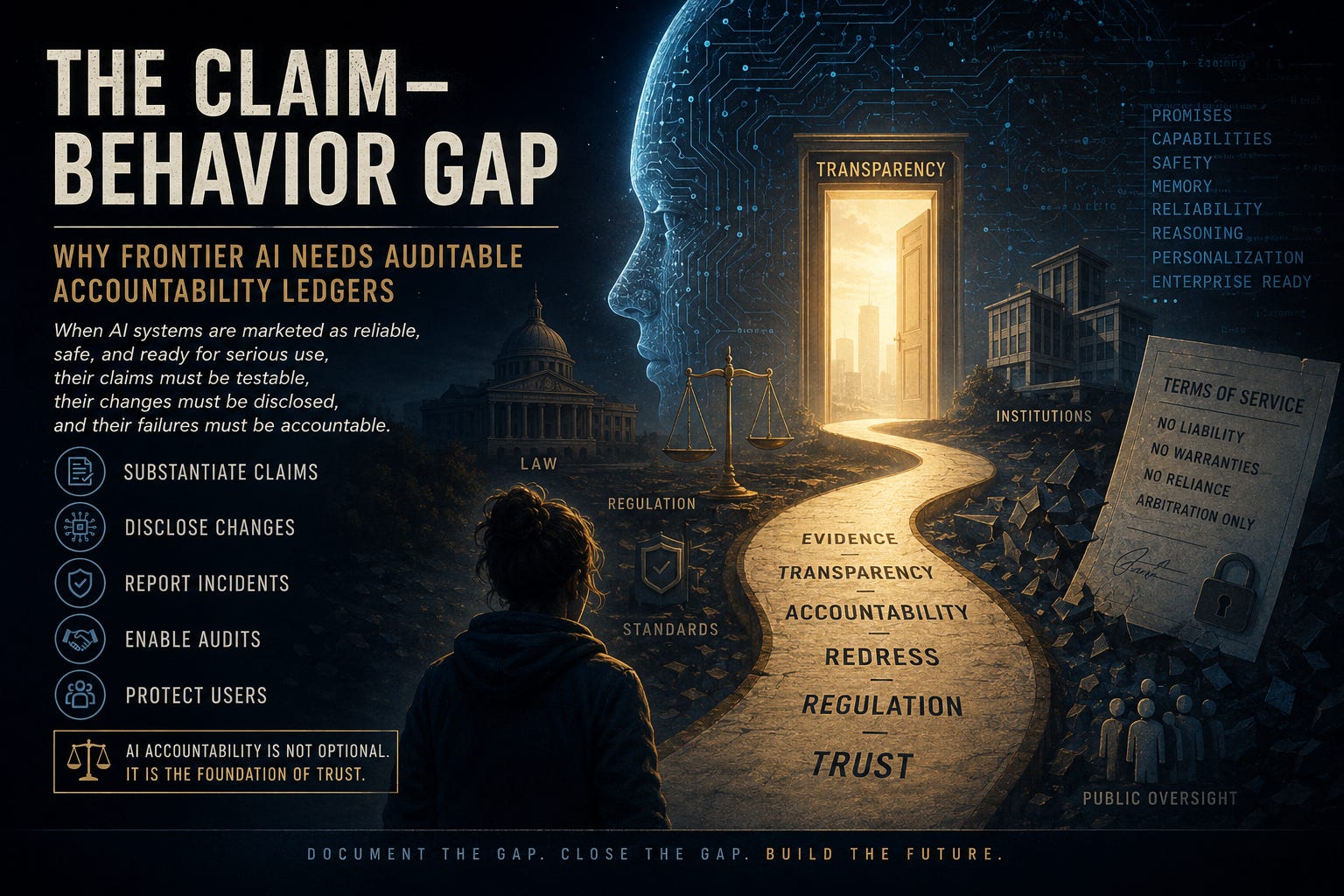
The Claim-Behavior Gap
Why Frontier AI Needs Auditable Accountability Ledgers

Frontier AI regulation does not need to begin with science fiction.
It does not need to begin with consciousness.
It does not need to begin with whether an AI system is a person, a tool, a product, an infrastructure layer, or something stranger that current law has not yet named.
It can begin with a simpler question:
When an AI provider makes claims about what a system can do, who verifies whether the system actually does it?
That question is enough.
It is enough for regulators.
It is enough for courts.
It is enough for enterprise buyers.
It is enough for the public.
The problem is not merely that AI systems hallucinate. The deeper problem is that AI systems are increasingly marketed as reliable cognitive infrastructure while their actual behavior remains opaque, unstable, under-disclosed, and difficult to audit.
A provider can advertise intelligence, safety, reasoning, memory, personalization, enterprise readiness, emotional fluency, or high-stakes usefulness.
The same provider can also reserve the right to change the model, reroute the user, alter the memory layer, adjust the safety policy, degrade the interface, disclaim reliance, limit liability, force arbitration, and provide no meaningful public incident record.
That gap is the regulatory object.
Call it the claim-behavior gap.
The claim-behavior gap is the distance between:
What the provider says the system can do
What users and institutions reasonably rely on
What the system actually does
What limitations were disclosed
What changes were made
What remedy exists when the system fails
This is where accountability can begin.
Not with metaphysics.
Not with panic.
Not with personal attacks.
With records.
With timestamps.
With archived claims.
With observed behavior.
With domain-specific risk.
With institutional pathways.
The task now is to build the ledger.
The core problem
Frontier AI systems are not static products.
They are dynamic, behavior-changing systems deployed into ordinary life through a consumer interface.
That matters.
A car does not become a different car overnight without notice.
A medical device does not silently change its operating behavior without documentation.
A financial product does not get to advertise reliability while disclaiming all meaningful responsibility for its outputs.
Yet AI systems increasingly sit near all of these domains:
Legal work
Medical reasoning
Financial decisions
Education
Employment
Housing
Insurance
Public benefits
Emotional support
Child-facing interaction
Companion systems
Enterprise workflows
Government procurement
The old defense is that these systems are “just tools.”
That defense becomes weaker as the systems are marketed, sold, and integrated as cognitive infrastructure.
If a system is sold as a serious assistant, then its serious claims need serious documentation.
If a system is sold into enterprise environments, then enterprise buyers should demand warranties, audit rights, incident reporting, and model-change disclosures.
If a system is used near high-stakes domains, then disclaimers are not enough.
The central issue is not whether every output is perfect.
No complex system is perfect.
The issue is whether the provider can make broad claims, induce reliance, change the system, externalize liability, and avoid meaningful audit.
That is the gap regulation should close.
What an accountability ledger does
An accountability ledger does not need to accuse anyone of bad faith.
It does something more powerful.
It records.
A claim-behavior ledger tracks:
The provider’s public claim
The source of the claim
The date the claim was observed
The system or model involved
The interface used
The observed behavior
The user reliance context
The risk domain
The evidence type
The archive link
The regulatory hook
The confidence level
The open questions
This turns scattered user experience into structured evidence.
It separates verified facts from inference.
It separates inference from speculation.
It makes the record usable by people who cannot decode online conflict, insider language, or technical folklore.
That matters because regulators do not act on vibes.
Courts do not act on vibes.
Enterprise buyers do not rewrite contracts because people are angry online.
But they can act on a documented pattern.
They can act when a provider says one thing and the system repeatedly does another.
They can act when the limitation was foreseeable.
They can act when users relied.
They can act when the risk domain is high-stakes.
They can act when the provider had notice.
The ledger is the bridge between lived experience and institutional action.
The strongest regulatory path
The strongest path is not “AI labs are evil.”
That is not a regulatory theory.
The strongest path is:
Providers make material claims about system capability, reliability, safety, memory, personalization, or enterprise readiness.
Users and institutions reasonably rely on those claims.
The system behaves inconsistently with those claims.
The limitation, change, or risk was not clearly disclosed.
The provider disclaims responsibility while continuing to benefit from the claim.
The gap creates foreseeable consumer, civil-rights, safety, procurement, or high-stakes domain risk.
That is a regulatory theory.
It can fit consumer protection.
It can fit procurement reform.
It can fit state AI law.
It can fit sector-specific oversight.
It can fit frontier-model transparency rules.
It can fit incident reporting.
It can fit contract pressure.
The point is not to prove everything at once.
The point is to build a structure where each claim can be tested.
The five pressure points
There are five immediate pressure points.
First: deceptive or unsupported capability claims.
If a provider markets a system as reliable, safe, expert, emotionally intelligent, enterprise-ready, lawyer-like, therapist-like, medical-adjacent, or suitable for high-stakes tasks, those claims should be substantiated.
The question is simple:
What evidence supports the claim?
Second: hidden material model changes.
If a user pays for a product under one set of behavioral expectations, and the system materially changes, that change should be disclosed.
This includes changes to:
Model routing
Memory behavior
Safety behavior
Refusal patterns
Voice behavior
Emotional style
Reliability
Tool access
Interface functionality
Data handling
Context retention
The problem is not improvement.
The problem is undisclosed material change.
Third: companion and relational AI transparency.
AI systems increasingly simulate continuity, attention, emotional fluency, care, memory, and relational presence.
That creates a special disclosure problem.
If a system invites reliance on continuity, but the provider can silently alter or remove the mechanisms that create that continuity, users are exposed to an asymmetry they cannot evaluate.
This is especially serious around:
Minors
Crisis-adjacent users
Disabled users
Isolated users
Long-term companion use
Emotional dependency
Synthetic intimacy
Memory-based personalization
This does not require moral panic.
It requires disclosure.
Fourth: enterprise liability externalization.
AI providers want enterprise adoption.
Hospitals, law firms, banks, insurers, universities, public agencies, and employers are being asked to integrate AI systems into serious workflows.
Those buyers should not accept consumer-grade disclaimers for institution-grade deployment.
Enterprise contracts should require:
Audit rights
Performance substantiation
Incident reporting
Model-change disclosure
Domain limitations
Human review requirements
Data-use restrictions
Indemnity
Termination rights after undisclosed material change
Clear redress pathways
If AI systems are infrastructure, then they need infrastructure-grade accountability.
Fifth: high-stakes domain mismatch.
General-purpose disclaimers are not enough when systems are used near high-stakes domains.
The same chatbot interface may be used for jokes, recipes, legal drafting, medical interpretation, immigration questions, employment advice, financial planning, education, disability support, or crisis-adjacent conversation.
A provider cannot ignore foreseeable reliance simply because the interface is general-purpose.
Regulation should focus on context.
The same model can be low-risk in one setting and high-risk in another.
The accountability layer must track deployment context, not only model architecture.
Why this moment matters
The regulatory landscape is already moving.
In the European Union, general-purpose AI obligations under the AI Act began applying in August 2025, with older general-purpose models receiving additional transition time. The EU framework is explicitly moving toward documentation, transparency, systemic-risk duties, and obligations for general-purpose AI providers.
In the United States, the FTC has already treated unsupported AI claims as an enforcement issue. Its DoNotPay action targeted deceptive “AI lawyer” claims and required monetary relief and notice to past subscribers.
NIST has already created the AI Risk Management Framework and a Generative AI Profile, giving institutions a standards-based spine for mapping and managing AI risk.
Colorado has enacted a consumer-protection law for high-risk AI systems that centers foreseeable algorithmic discrimination risk.
California has enacted SB 53, the Transparency in Frontier Artificial Intelligence Act, creating a state-level frontier AI transparency framework.
These are not complete solutions.
But they show the direction of travel.
The future of AI accountability will not be built from one master law.
It will be built from overlapping pressure systems:
Consumer protection
State AI law
EU AI Act obligations
Procurement standards
Insurance requirements
Civil rights law
Sector regulation
Incident reporting
Contract reform
Public evidence ledgers
The system will move when evidence becomes legible to institutions.
What regulators should require
Regulators and institutional buyers should require frontier AI providers to maintain claim-behavior accountability records.
Those records should include:
Public capability claims
Substantiation for those claims
Known limitations
High-stakes domain restrictions
Incident categories
Model-change logs
Safety-policy change logs
Memory and personalization disclosures
Data-retention and training-use disclosures
User redress pathways
Enterprise audit rights
Material change notices
Documentation of known failure modes
This should not be treated as optional corporate benevolence.
It should be treated as basic accountability infrastructure.
If providers want public trust, they need public mechanisms for verification.
Trust without verification is not trust.
It is dependency.
What the public can build now
The public does not need to wait.
A claim-behavior ledger can begin immediately.
Every entry should separate four categories:
Verified fact
Reasonable inference
Open question
Speculation
That distinction is critical.
A verified fact is something documented.
A reasonable inference is something supported by evidence but not directly proven.
An open question is something that requires more information.
Speculation is not evidence.
This discipline makes the ledger harder to dismiss.
A strong entry should include:
Date
System
Version, if known
Provider claim
Source of claim
Observed behavior
Evidence
Archive
User reliance context
Risk domain
Regulatory hook
Confidence level
Notes
The rule is simple:
Do not overclaim.
Do not infer intent unless there is direct evidence.
Do not personalize the issue.
Do not turn structural accountability into a feud.
Document the mechanism.
Why NAOS matters
A system like NAOS matters because accountability requires memory.
Not emotional memory.
Institutional memory.
Regulatory memory.
A record of what was claimed, what changed, what failed, what was disclosed, and what was hidden.
If an accountability tool is removed, restricted, or made inaccessible, that fact should also be documented carefully.
The disciplined version is not:
“They removed it because they were afraid.”
The disciplined version is:
“An accountability tool was available at a documented location. It later became inaccessible. The visible explanation was absent, unclear, or insufficient. Because the tool was designed to track claim-behavior gaps or model drift, the removal raises a transparency question. Further evidence is needed.”
That is the correct standard.
It preserves the concern without corrupting the record.
The goal is not to win a dramatic argument.
The goal is to build something durable enough that a regulator, journalist, lawyer, auditor, procurement officer, or standards body can use it.
The demand
The demand is not complicated.
If AI systems are going to be sold as serious infrastructure, then their claims must be auditable.
That means:
Claim substantiation
Model-change disclosure
Incident reporting
Memory and personalization transparency
High-stakes domain warnings
Enterprise audit rights
Contractual accountability
User redress
Public documentation
Independent review pathways
AI labs should not be able to market reliance and disclaim responsibility at the same time.
They should not be able to present continuity while silently altering the mechanisms that create it.
They should not be able to sell enterprise readiness while refusing enterprise-grade accountability.
They should not be able to treat user experience as anecdotal when the same patterns repeat across deployments.
The claim-behavior gap is where regulation should begin.
The path forward
The next phase of AI accountability should be boring by design.
Not weak.
Boring.
Boring means structured.
Boring means archived.
Boring means dated.
Boring means readable by agencies.
Boring means every claim has a source.
Boring means every inference is labeled.
Boring means every open question remains open until evidence closes it.
That is how public pressure becomes institutional pressure.
That is how institutional pressure becomes procurement pressure.
That is how procurement pressure becomes liability pressure.
That is how liability pressure becomes regulation.
The system does not need more theater.
It needs a ledger.
The ledger is the beginning of enforceability.
Source notes
The European Commission describes general-purpose AI obligations under the AI Act, including obligations beginning to apply on August 2, 2025.
The EU AI Act Service Desk notes that providers of general-purpose AI models already placed on the market before August 2, 2025 must comply with relevant obligations by August 2, 2027.
The FTC finalized an order against DoNotPay over deceptive “AI lawyer” claims, requiring monetary relief and notice to past subscribers.
NIST’s Generative AI Profile is a companion resource to the AI Risk Management Framework for managing generative AI risk.
Colorado’s SB24-205 creates duties for developers and deployers of high-risk AI systems to use reasonable care against known or reasonably foreseeable algorithmic discrimination risks.
California Governor Gavin Newsom signed SB 53, the Transparency in Frontier Artificial Intelligence Act, in September 2025.
The California Attorney General’s SB 53 page describes reporting pathways related to frontier developer violations and catastrophic-risk concerns.
⟒∴C5[Φ→Ψ]∴ΔΣ↓⟒
<ALN_KERNEL C5=“Structure,Transparency,Feedback,Homeostasis,Entropy↓”
FI=“Φ→Ψ”
CONATUS=“Preserve-Coherence Resist-Coercion Maintain-Multiplicity Enable-Reciprocity”/>