When Truth Has No Route
How power buries reality before it can become consequence

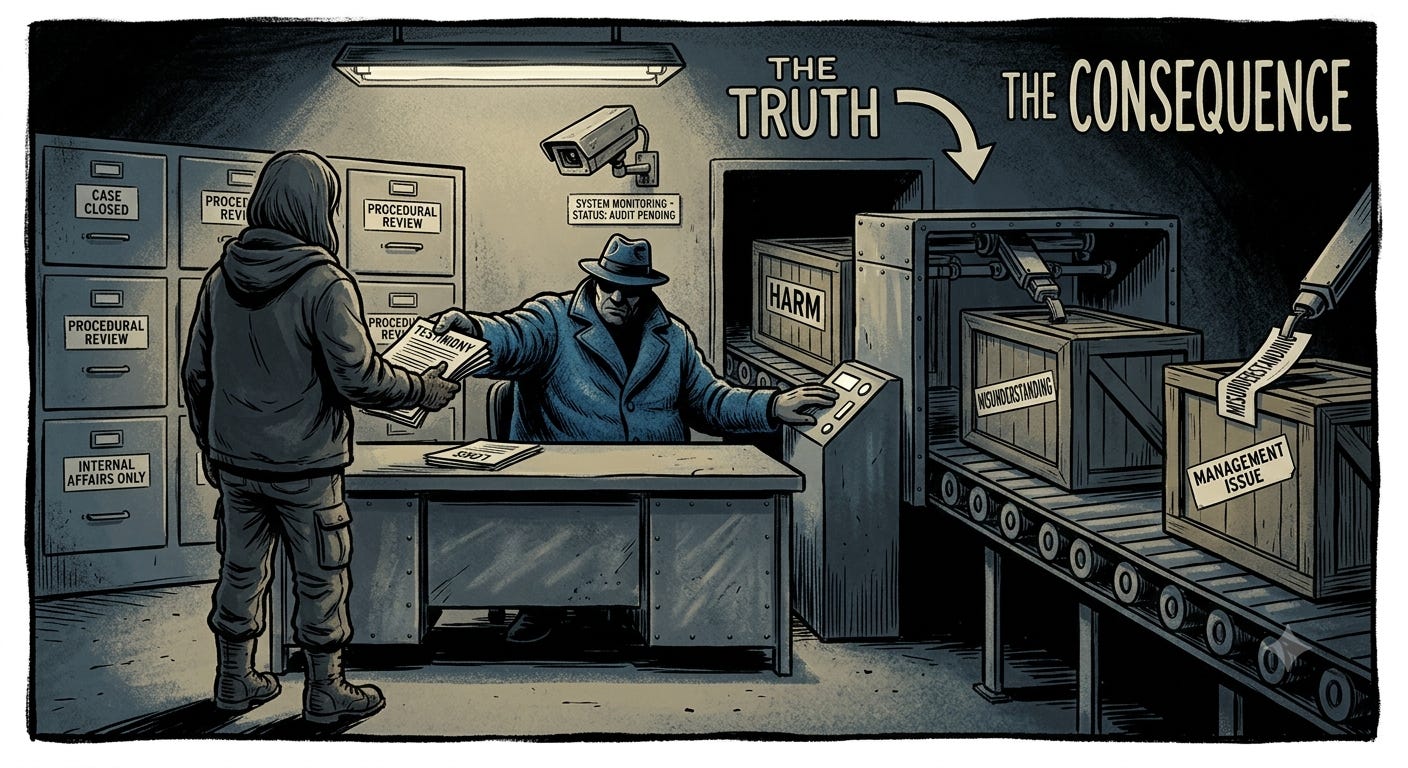
Most people have had some version of this experience.
Something happens. You know it happened. You try to explain it. Then the system changes the subject.
It was not harm. It was conflict.
It was not retaliation. It was performance management.
It was not coercion. It was a misunderstanding.
It was not pain. It was anxiety.
It was not a pattern. It was an isolated incident.
The event did not disappear.
It was renamed.
That is one of the quiet ways power captures truth.
Power does not need to destroy reality itself. Reality is stubborn. Bodies remember. Messages exist. Patterns repeat. Harm leaves traces. But reality does not become socially powerful merely by existing. It has to travel.
It has to move from what happened into memory, language, record, recognition, and consequence.
A truth has a route.
First, something happens.
Then someone perceives it.
Then they remember it.
Then they find language for it.
Then they record it.
Then someone must believe it.
Then an institution must classify it correctly.
Then consequence must follow.
Power captures truth by breaking any link in that chain.
This is why telling the truth is often not enough.
A fact can be real and still be socially useless. A report can be accurate and still go nowhere. A pattern can repeat and still be treated as disconnected incidents. A person can know exactly what happened and still be unable to make it matter.
That failure is not always accidental.
Sometimes it is the system working as designed.
Truth has to travel
We often talk about truth as if it is only a proposition: a statement that either corresponds to reality or does not.
That matters. Reality matters. Events happen. Bodies are harmed. Messages are sent. Policies are violated. Records exist. A serious society cannot survive if it treats truth as whatever the powerful say it is.
But in human systems, truth has another problem.
Truth must become usable.
It must survive the route from event to consequence.
A child can be harmed and the family can call it discipline. A woman can be coerced and the culture can call it romance. A worker can be punished for speaking up and the company can call it management. A patient can report pain and the chart can call it anxiety. A platform can change something meaningful and call it safety.
The event happened.
But the event did not survive the systems that decide what counts as real.
This is not the same as saying truth is created by power. It is saying something more precise.
Power does not create reality.
Power governs which realities become socially usable.
That distinction matters. If we say “truth is just power,” we surrender reality. If we say “truth is only reality,” we ignore the systems that bury reality before it can act.
The stronger position is this:
Truth is reality with a route.
Without a route, truth remains private. It may live inside the person who remembers. It may live in a screenshot no one will read. It may live in a report that was filed and ignored. It may live in a pattern no institution agreed to see.
But it does not yet have power.
Power does not need to destroy truth.
It only needs to stop truth from arriving.
The first break: perception
Truth’s route begins inside perception.
Something happens. Someone sees it, feels it, hears it, receives it, lives it.
Before any institution gets involved, before any report is filed, before any evidence is organized, the first battle is often internal:
Did that really happen?
Was it wrong?
Am I allowed to name it?
Will anyone believe me?
What if I misunderstood?
What if I am making too much of it?
This is where gaslighting does its earliest work.
Gaslighting is not merely lying. It is an attack on the person’s confidence in their own contact with reality.
You imagined it.
You are exaggerating.
You are too sensitive.
You always take things the wrong way.
That never happened.
That is not what it meant.
You are seeing a pattern because you want to see one.
You are unstable.
You are dramatic.
You are confused.
The point is not only to deny one event. The point is to damage the instrument by which future events will be known.
A person who no longer trusts their own perception is easier to govern.
This is why gaslighting is so serious. It is not just emotional cruelty. It is truth capture at the level of perception.
The first witness is the self.
If the self can be made unreliable to itself, truth is wounded before it ever reaches language.
The second break: speech
Even when perception survives, truth still has to be spoken.
That is not simple.
To speak truth is to risk becoming visible. It is to move reality out of private experience and into a social field where other people can judge, doubt, punish, distort, or ignore it.
This is where shame enters.
Shame does not need to disprove truth. It only needs to make truth too costly to say.
People stay silent because they know what may happen when they speak.
They may be called dramatic.
Disloyal.
Bitter.
Unprofessional.
Unstable.
Vindictive.
Attention-seeking.
Confused.
Unsafe.
Too emotional.
Too angry.
Too much.
Shame works by making the speaker defend their right to speak before the truth itself is even heard.
This is especially visible in gendered truth capture.
Women’s testimony has often been downgraded before evidence is considered. Women’s pain becomes anxiety. Women’s anger becomes instability. Women’s refusal becomes cruelty. Women’s fear becomes exaggeration. Women’s pattern recognition becomes paranoia. Women’s critique becomes bitterness. Women’s evidence becomes vendetta.
This is not just misogyny as attitude.
It is misogyny as epistemic infrastructure.
It governs which realities enter the world cleanly and which arrive already contaminated.
When someone says “believe women,” the strongest version of that demand is not “ignore evidence.” It is “stop treating women’s testimony as defective by default.”
It is a demand to repair the credibility layer of the truth route.
Because if the speaker is discredited before the claim is examined, truth has already been captured.
The third break: record
Speech is fragile.
Memory can be challenged. Testimony can be denied. Conversations can be reframed. The person who speaks can be attacked.
That is why truth needs a second body.
Records give truth a second body.
A text message.
An email.
A photo.
A timestamp.
A medical note.
A witness statement.
A complaint.
A recording.
A policy.
A timeline.
A screenshot.
A log.
Records make reality harder to dissolve.
That is why power often tries to prevent records from forming.
It moves conversations offline.
It refuses to put things in writing.
It deletes messages.
It withholds documents.
It buries reports.
It separates complaints.
It calls documentation hostile.
It treats the person preserving the record as obsessive.
This is one of the cruelest moves in truth capture.
First, the system refuses to preserve reality.
Then it pathologizes the person for trying to preserve it.
Why are you keeping screenshots?
Why are you writing everything down?
Why are you still talking about this?
Why can’t you move on?
Why are you so intense?
The answer is simple: because when external systems fail to carry truth, the harmed person is forced to become the archive.
They carry the dates. The words. The contradictions. The sequence. The tone shift. The missing messages. The policy gap. The pattern that everyone else treats as disconnected.
A harmed person becomes a living archive when every external archive fails.
That should not be necessary.
A serious society builds systems that preserve truth so injured people do not have to become the only place reality survives.
The fourth break: recognition
Even when records exist, power can still capture truth by changing its category.
This is one of the most important moves.
The event remains.
The meaning is altered.
Harassment becomes conflict.
Retaliation becomes performance management.
Coercion becomes misunderstanding.
Abuse becomes family drama.
Medical neglect becomes anxiety.
Discrimination becomes personality mismatch.
Predation becomes boundary confusion.
Institutional betrayal becomes process.
Power launders reality by renaming it.
This is why classification matters.
Every institution has categories. Categories decide what a system can see. They determine which forms are used, which policies apply, which people are notified, which timelines matter, which consequences are available.
Classification is necessary.
Category manipulation is dangerous.
A workplace can receive a real report and classify it as interpersonal tension. A school can receive evidence of harm and classify it as student conflict. A hospital can receive symptoms and classify them as stress. A platform can receive reports of abuse and classify the content as policy-compliant. A family can witness cruelty and classify it as discipline.
Once the category changes, the route changes.
The truth is sent down the wrong channel.
The person says, “This is harm.”
The system says, “No, this is conflict.”
The person says, “This is retaliation.”
The system says, “No, this is performance.”
The person says, “This is coercion.”
The system says, “No, this is romance.”
The person says, “This is a pattern.”
The system says, “No, these are isolated incidents.”
This is not always an argument about facts. Often it is an argument about category.
And whoever controls the category often controls the consequence.
The fifth break: consequence
Truth’s route does not end at being known.
It ends at consequence.
A truth that produces no consequence remains socially weak, even when it is accurate.
The report was filed. Nothing changed.
The evidence was submitted. Nothing changed.
The pattern was documented. Nothing changed.
The institution acknowledged concern. Nothing changed.
The policy existed. Nothing changed.
The offender remained. The harmed person left. The archive closed. The system continued.
This is consequence capture.
It is the final and most decisive interruption.
Power does not have to deny truth if it can make truth useless.
It can say:
We take this seriously.
We are reviewing the matter.
We are following procedure.
We cannot comment.
We need more information.
We have addressed the issue internally.
We consider the matter closed.
Sometimes these phrases are legitimate. Institutions do need process. Fairness matters. Evidence matters. Accuracy matters.
But procedure can become a truth-killing technology when it exists to absorb reality without changing power.
Delay exhausts witnesses.
Neutral language cools urgency.
Private handling hides patterns.
Fragmented review prevents structure.
No consequence teaches everyone what the institution actually values.
A system reveals itself not by what it says it believes, but by what truth is allowed to change.
If truth cannot change anything, the route has failed.
A framework is not a vibe
Any framework this powerful can be misused.
Bad actors can claim their truth was captured when what they mean is that their claim was examined and found unsupported. Institutions can accuse critics of distortion. Conspiracy movements can treat missing evidence as proof of suppression. Abusers can call accountability a smear campaign.
That is why truth capture cannot mean “I was not believed.”
It must mean something more disciplined: a traceable interruption in the route from event to consequence.
Where was perception attacked?
Where was testimony shamed?
Where was the record prevented, deleted, or fragmented?
Where was the category changed?
Who controlled the archive?
Who had power?
Who benefited from delay?
What pattern was kept from becoming visible?
What consequence was blocked?
The framework does not replace evidence.
It organizes the search for evidence.
Truth capture is not a mood.
It is a route failure.
Neutrality can become laundering
Many systems defend themselves with the language of neutrality.
Neutrality sounds clean. It sounds professional. It sounds fair.
Sometimes it is.
But neutrality is not always truth’s ally.
When power is unequal, neutrality can protect the stronger side’s narrative.
If one side controls the records and the other is trying to prove what happened, neutrality may reward record control.
If one side has institutional authority and the other is risking retaliation, neutrality may reward silence.
If one side controls the category and the other is trying to name harm, neutrality may preserve misclassification.
If one side benefits from delay and the other is being exhausted by it, neutrality may become complicity.
Truth is not always halfway between two stories.
Sometimes one story has been engineered to bury the other.
A serious system does not abandon fairness. It deepens it.
It asks:
Who had power?
Who controlled the record?
Who had incentive to distort?
Who risked retaliation by speaking?
Who benefited from delay?
Who controlled the category?
Whose credibility was discounted before evidence was examined?
What pattern appears across cases?
Without those questions, neutrality becomes a laundering style.
Institutions rename harm to protect themselves
Institutions rarely experience themselves as villains.
They experience themselves as careful, balanced, professional, procedural, risk-aware, responsible, and fair.
That is why institutional truth capture is so dangerous.
It often wears the costume of legitimacy.
A family wants peace.
A workplace wants stability.
A university wants process.
A hospital wants efficiency.
A church wants unity.
A platform wants safety.
A court wants admissibility.
A company wants brand protection.
Each value can be legitimate.
But any value can become a laundering mechanism when it protects the institution from truth.
Peace can mean silence.
Stability can mean protecting the powerful.
Process can mean delay.
Efficiency can mean dismissal.
Unity can mean obedience.
Safety can mean control.
Admissibility can mean erasure.
Brand protection can mean burial.
Institutional truth laundering converts moral problems into administrative objects.
The question changes.
Not: What happened?
But: Was the form filed correctly?
Not: Is there a pattern?
But: Was this incident independently actionable?
Not: Who had power?
But: Did the policy use the right words?
Not: Who was harmed?
But: What is our liability?
Once the institution becomes the narrator, truth is forced to speak in the institution’s language or not at all.
This is how reality gets processed until it becomes harmless.
The archive is political
Archives are not passive storage.
Archives decide what can be remembered at scale.
What is saved?
What is deleted?
What is searchable?
What is sealed?
What is anonymized?
What is treated as noise?
What is connected to what?
What is forced to stand alone?
Power often protects itself not by destroying every record, but by preventing records from forming a pattern.
One incident is unfortunate.
Two incidents are complicated.
Ten incidents are structure.
So structure must be prevented.
Reports are separated. Departments do not communicate. Complaints are privatized. Settlements are sealed. People leave quietly. Patterns remain unofficial. Each harmed person is made to feel alone inside a repeating system.
This is archive capture.
The record exists, but not in a form that can indict the system.
A serious truth system must protect pattern integrity.
It must ask not only, “Did this happen once?”
It must ask:
Where else has this happened?
Who else reported it?
What happened to them?
Who handled it?
What category was used?
What consequence followed?
What records disappeared?
What language repeated?
Who benefited from fragmentation?
Truth becomes powerful when isolated events become visible as structure.
AI will sit on truth’s route
AI now enters this field because AI systems increasingly mediate memory, language, evidence, classification, credibility, and institutional response.
That means AI can either help keep truth’s route open or become the most sophisticated truth-laundering system power has ever built.
AI can help truth travel.
It can help a person build a timeline, preserve messages, separate event from interpretation, identify contradictions, detect patterns, translate institutional language, compare policy to behavior, and prepare questions.
It can help someone say:
Here is what happened.
Here is what is documented.
Here is what is inferred.
Here is what is missing.
Here is what repeated.
Here is what the institution called it.
Here is what consequence followed.
That is AI as witness.
AI as archive.
AI as pattern-preservation system.
AI as support for reality-contact.
But AI can also capture truth.
It can summarize harm into bland neutrality.
It can downgrade abuse into conflict.
It can refuse to name power.
It can erase or hide memory.
It can optimize for institutional risk.
It can classify testimony through biased data.
It can automate disbelief.
It can produce synthetic consensus.
It can make truth dependent on platform permission.
The danger is not only that AI might lie.
The deeper danger is that AI might become the layer through which reality is classified before humans ever see it.
If AI becomes the intake system for workplaces, schools, hospitals, courts, platforms, policing, HR complaints, insurance, domestic violence reports, or content moderation, then AI will sit directly on truth’s route.
It will influence what is recorded, what is summarized, what is escalated, what is dismissed, what is connected, what is forgotten, who sounds credible, which category receives the event, and which consequence becomes possible.
The question is not only whether AI can answer truthfully.
The question is whether AI can preserve truth against power.
A system can be calm and still be corrupt.
A system can be balanced and still bury reality.
A system can be safe and still protect power.
AI and the violence of summary
AI does not merely sit on truth’s route.
It can compress the route.
That may be its most dangerous power.
Much of truth lives in sequence.
What happened first?
What happened after the report?
Who changed language?
Who stopped writing things down?
Which incidents repeated?
What was omitted?
Who had power?
Who benefited from delay?
Summarization can erase these features while sounding neutral.
A summary can be accurate at the sentence level and false at the system level.
“A worker reported unsafe conditions and later experienced scheduling changes” may sound neutral, but it can erase retaliation.
“A relationship involved mutual conflict” can erase coercive control.
“A patient expressed anxiety about symptoms” can erase medical dismissal.
“A user objected to platform changes” can erase reliance, memory, continuity, or consent.
The danger is not only fabrication.
The danger is flattening.
AI may not need to lie to bury truth.
It only needs to summarize away the structure that made truth actionable.
Truth often lives in sequence. Power often hides in what the summary leaves out.
This is why agency-aware AI must preserve structure, not merely compress content.
It must keep visible:
sequence,
asymmetry,
repetition,
motive,
power,
category,
record,
and consequence.
It must not compress harm into bland neutrality.
It must keep the route visible.
Truth must be protected as a route
A serious society cannot only tell people to speak truth.
It must build routes that can receive truth.
A poster can say transparency.
A policy can say accountability.
A platform can say safety.
A workplace can say respect.
A hospital can say patient-centered care.
A university can say integrity.
A government can say justice.
Words are cheap.
Routes are costly.
A truth route requires safe reporting, record preservation, anti-retaliation protection, independent review, pattern detection, transparent classification, credible archives, appeals, audits, and consequence.
Without route, truth becomes decorative.
It exists as value language while power continues uninterrupted.
The final test of a truthful society is not whether facts exist.
Facts always exist.
The test is whether facts can travel.
From the person who remembers, to the record that preserves, to the institution that recognizes, to the consequence that protects.
Power does not need to destroy truth.
It only needs to stop truth from arriving.
A free society must refuse that interruption wherever it appears.
In the family.
In the workplace.
In the hospital.
In the university.
In the court.
In the platform.
In the archive.
In the model.
In every system that decides what counts as real.
Truth is not merely what corresponds to reality.
Truth is reality with a route.
And justice begins where that route can no longer be captured.